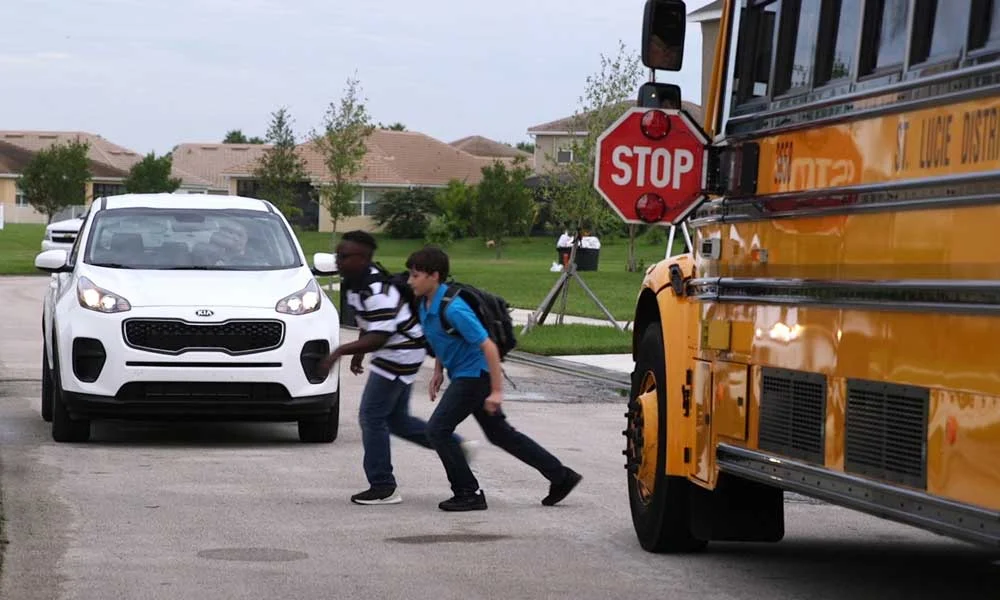
While the yellow school bus is designed to be the safest vehicle on the road, the ten feet of pavement surrounding it during the loading and unloading of students tells a different story.
Statistically, students are 70 times more likely to arrive at school safely when riding inside the bus than when traveling by passenger car—yet that safety disappears the moment they step onto the curb. This high-stakes environment, known as the Danger Zone, is where most school bus-related injuries occur, often involving motorists who fail to stop or blind spots that hide small children from view.
To protect students, we have to understand the risks they face anytime they’re outside the bus—whether waiting at the stop, crossing the street, or boarding and exiting.
This guide explores the dangers of this critical area and the proactive technologies designed to close the safety gap.
1. The Reality of the Danger Zone
Two primary threats define the Danger Zone as a high-risk environment: distracted drivers passing or approaching the bus, and visibility limitations that make it difficult to see children around it.
The Scale of Illegal Passing
Every school day, an estimated 251,000 illegal pass-bys occur. Over a standard 180‑day school year, that represents more than 45 million instances where children are exposed to drivers who ignored or missed a stop‑arm. The tragedy of these stop-arm violations is that they are entirely preventable, yet they remain the leading cause of student injury during loading/unloading.
The Visibility Gap
Because of their size, school buses have significant blind spots directly in front, behind, and along the sides. According to National Safety Council data, school‑age children face the greatest risk during loading and unloading, when they are outside the bus and most vulnerable—often because they are simply not seen by drivers.
2. How to Address the Illegal Passing Crisis?
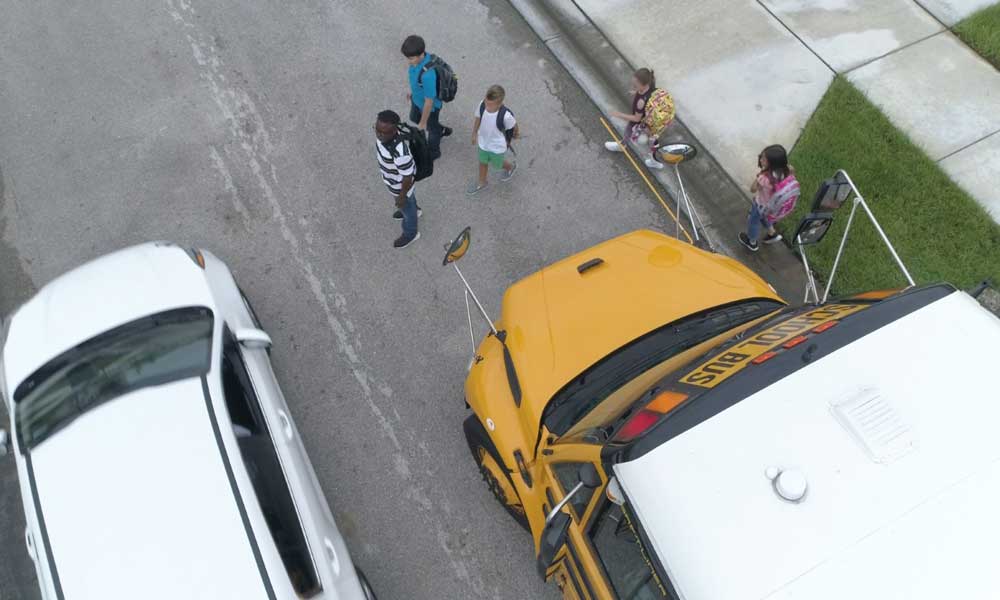
Safe Fleet addresses these risks through the Illegal Passing Suite—a multi‑layered safety approach designed to change driver behavior and protect students during the most dangerous moments of their commute.
At the core of the suite is SAVES (Safe Fleet’s Automated Stop‑Arm Violation Enforcement System), which detects illegal pass‑bys, captures evidentiary video, and plays a direct role in the citation process. The system packages each violation for review and helps automate enforcement after a multi‑step validation process involving AI analysis, civilian review, and law enforcement approval.
Together, the suite delivers a coordinated approach across three stages: Prevention, Proactive Protection, and Accountability.
The Risk: Driver Inattention
Many drivers don’t ignore stop arms out of malice; they simply don’t see the bus in time to react.
- The Solution: The Illuminated Stop Arm and Driver Alert Sign.
- How they work: By combining high-intensity LED illumination with advanced visual signaling, both solutions work together to capture driver attention earlier and more effectively.
The Illuminated Stop Arm enhances the visibility of the bus’s stop signal with bright LEDs and reflective prismatic decals, making the “STOP” message noticeable from up to 250 yards away.
Complementing this, the Driver Alert Sign adds an additional visual cue mounted on the rear or side of the bus, reinforcing the stop requirement and drawing attention from approaching motorists who may have missed the stop arm alone.
Together, these solutions provide the critical seconds drivers need to recognize the situation, process the command, and come to a safe stop well before reaching the bus.
The Risk: The “Point of No Return”
Once a driver fails to stop, the situation becomes immediately more dangerous for students in the Danger Zone.
- The Solution: Predictive Stop Arm™ (PSA).
- How it works: This is the industry’s primary proactive safety measure. Using patented radar to monitor up to three lanes of traffic, the PSA analyzes approaching vehicles and uses AI to identify when a driver is unlikely to stop.
In response, it broadcasts a loud, verbal “Stop, Get Back” warning to nearby students—giving them 3–4 critical seconds to move away from the roadway and out of harm’s way.
The Risk: Lack of Accountability
Without enforcement, illegal passing often goes unreported and unpunished, leaving drivers without consequences for dangerous behavior.
- The Solution: The Safe Fleet Stop Arm Violation Enforcement System™ (SAVES)
- How it works: Automatically activated when the stop arm is deployed, this AI‑powered system monitors up to four lanes of traffic using a synchronized multi‑camera configuration. It detects illegal pass‑bys, uses Automated License Plate Recognition (ALPR) to identify violating vehicles, and captures high‑definition contextual video—including a coordinated view of the bus door—to document the risk to students.
Each incident is compiled into a complete evidence package and validated through a multi-step review process involving AI analysis, trained civilian reviewers, and law enforcement. Once approved, the system automatically issues a citation—creating a consistent, enforceable process that helps deter future illegal passing
3. Added Security: Enhancing Driver Awareness
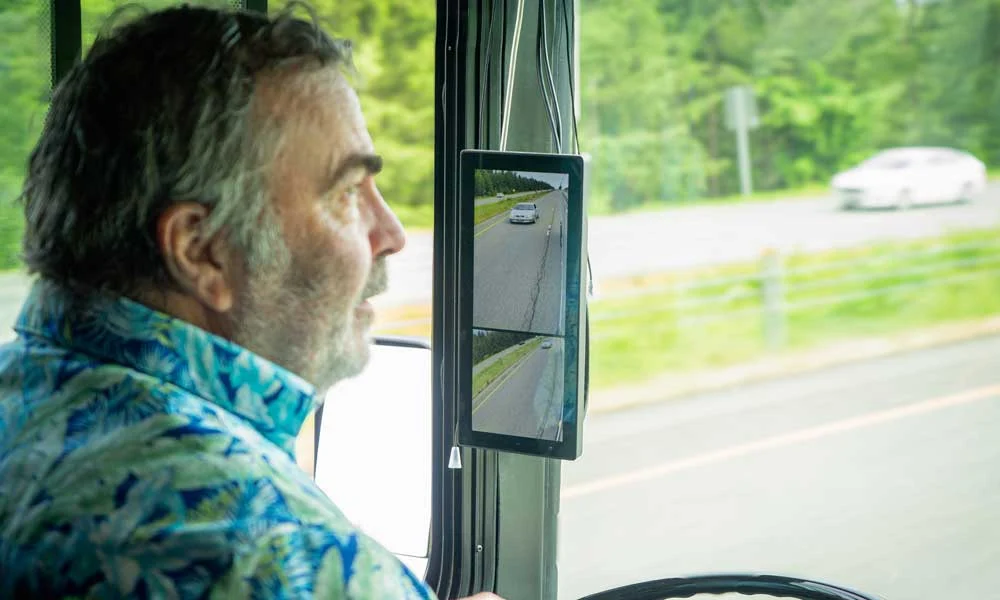
While the Illegal Passing Suite addresses external traffic behavior, the solutions below focus on what the bus driver sees from inside the vehicle—helping ensure no child is ever hidden in a blind spot.
Eliminating Blind Spots
The structural design of a bus—specifically the A-pillars—can hide a small child during a turn.
- InView 360HD™ Around Vehicle Monitoring (AVM): This system uses multiple cameras to create a stitched, bird’s-eye view of the vehicle’s perimeter, displayed on an in-cab monitor. It allows the driver to see every inch of the Danger Zone in real time, effectively eliminating blind spots during loading and unloading.
- MirrorLESS Vision System: This system supplements traditional side mirrors with high-definition cameras that provide a clear, digital view of the areas around the bus, displayed on in-cab monitors. Unlike conventional mirrors, these camera views remain consistent in low light and are not affected by glare, rain, or snow.
- When integrated with ThruView Assist™, a camera vision system designed to help drivers see beyond the A and B pillars of the cab, the system goes a step further. By displaying this extended field of view on an in-cab monitor, it allows drivers to effectively “see through” the body of the bus during left-hand turns—revealing pedestrians or vehicles that would otherwise be hidden from view.
Coaching Better Habits
The most critical safety component on any bus is the driver.
- Duet AI: This intelligent driver behavior system uses AI to detect fatigue, distraction, phone use, and harsh maneuvers. Drivers receive immediate alerts for real-time self-correction, while the cloud-connected cameras capture critical context to help investigate incidents and support professional driver growth through targeted coaching.
Building a Roadmap to Zero
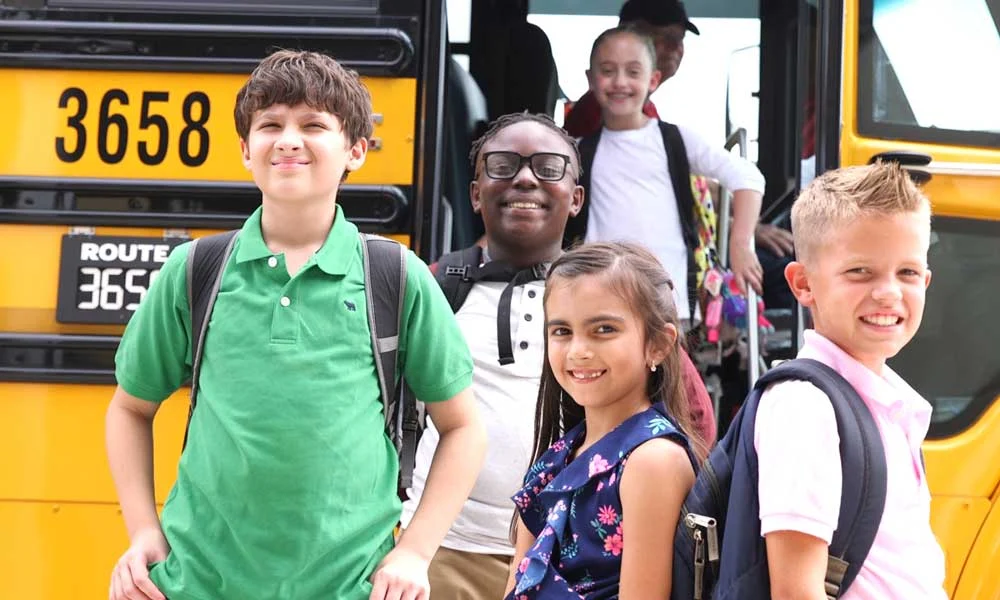
A layered safety strategy offers the best path to zero fatalities. Integrating high-visibility signage, proactive AI warnings, and comprehensive camera coverage creates a safety net that protects every student, every day.